Free CASPer Test Simulator: Try a Real Scenario Now
Reading about the CASPer test only gets you so far. The fastest way to understand it is to actually sit one scenario, type a real answer under pressure, and see how it scores. So that is exactly what this page lets you do. Scroll down, read the scenario, and write your response in the box. You will get instant feedback on where it lands and why.
Try the simulator
Give yourself five minutes. Read the scenario, answer all three questions in the box, and hit grade. Try not to overthink it. The point is to see how a normal, reasonable-sounding answer actually scores, because that gap is where most applicants lose marks without realizing it.
Free two-question sample
You are working on a group project. Jordan has missed the last two meetings and has not submitted their part. The deadline is in two days. Another teammate suggests removing Jordan’s name so the rest of the group is not penalized.
Read the scenario first. When you start, two questions will appear with 3 minutes 30 seconds shared between both answers.
Why "reasonable" answers land in the 2nd quartile
Almost everyone who takes CASPer writes answers that sound fine to them. The problem is that "fine" is the median. The raters are not looking for a correct answer, because there usually is not one. They are looking for evidence that you can do four things under time pressure:
Gather before you judge
Weak answers leap to a verdict. Strong answers slow down, acknowledge what they do not know, and decide what information they would gather first.
Hold more than one perspective
Name every person affected and what they need. A top-quartile answer can argue both sides before it commits to one.
Take concrete, sequenced action
Vague intentions score low. Say who you would talk to, what you would say, and what you would do if that did not work.
Adapt when facts change
The third question almost always adds new information. Your reasoning has to visibly shift, or you look rigid.
What a real CASPer simulator should give you
A single scenario is a great taste, but it is not enough to move your score. A simulator worth using has to mirror the real testing conditions and then tell you something useful afterward. Here is what to look for:
- The real timer. CASPer gives you a fixed window per scenario. If you practice untimed, you are training a skill the test does not measure.
- Fresh scenarios every time. Memorizing answers is useless. You need an endless supply so you are always reacting, not reciting.
- Feedback against the 10 competencies. A score with no explanation does not help you improve. You need to know which competency you missed and how to fix it.
- A projected quartile. The whole game is which quartile you land in. A simulator should estimate that so you can track progress week to week.
Want the full simulator, not just one scenario?
CasperCoach generates unlimited realistic scenarios, runs the real timer, scores all 10 competencies, and shows your projected quartile after every response. Start free with no card.
How to use the simulator to actually raise your score
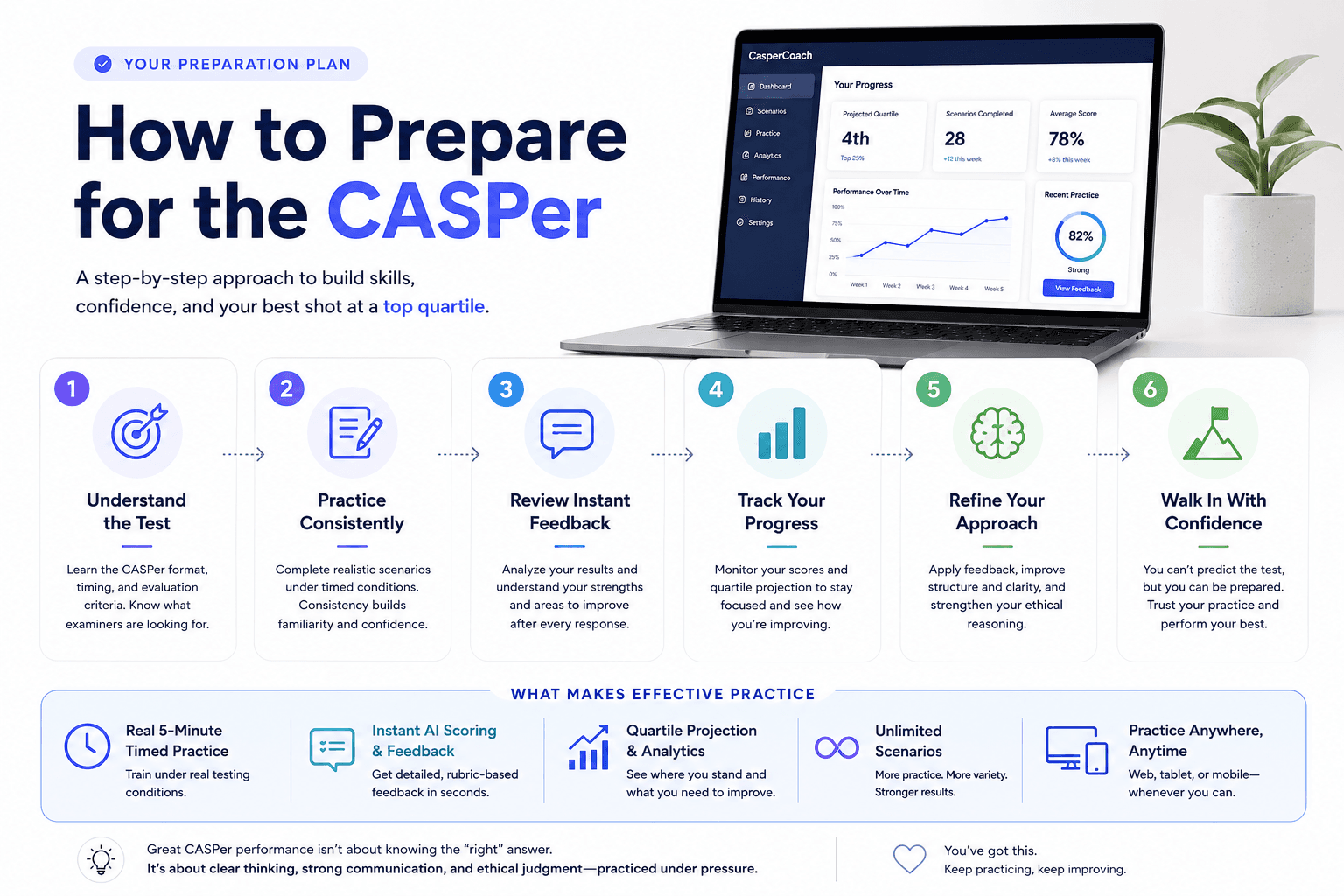
Doing scenarios at random will not move the needle. Use this simple loop, the same one shown in the infographic above:
- Do one scenario under the timer. No pausing, no second drafts. Treat it like the real thing.
- Read the feedback slowly. Find the single biggest weakness, not all of them. Trying to fix everything at once fixes nothing.
- Re-answer the same prompt fixing only that one thing. This is where the learning happens.
- Move to a fresh scenario and carry the fix forward. Repeat until the fix is automatic, then pick the next weakness.
Most students see their projected quartile climb within ten to fifteen scenarios when they review feedback this way. The ones who just churn through scenarios without reflecting tend to stay flat.
Frequently Asked Questions
Is this CASPer simulator free?+
Yes. The scenario and grader on this page are completely free and need no account. For unlimited fresh scenarios with full AI scoring on all 10 competencies, you can create a free CasperCoach account and use 3 scenarios with no card required.
Does the simulator use the real CASPer scoring system?+
The mini grader on this page is a teaching demo built around one fixed scenario, so it always returns a 2nd-quartile example with general feedback. The full CasperCoach engine reads your actual words and scores each of the 10 professional competencies the real raters use.
How close is this to the real CASPer test?+
The format matches: a short scenario, three probing questions, and a tight time limit. The real test runs roughly 90 to 110 minutes across about 14 sections that mix typed and video responses. Practicing single scenarios like this one is how you build the speed and structure to handle the full test.
How many practice scenarios should I do before test day?+
Most students who reach the 3rd or 4th quartile report doing 20 to 40 timed scenarios spread over two to four weeks. Quality matters more than volume: review feedback after every single one and fix one weakness at a time.